 HorecaHire

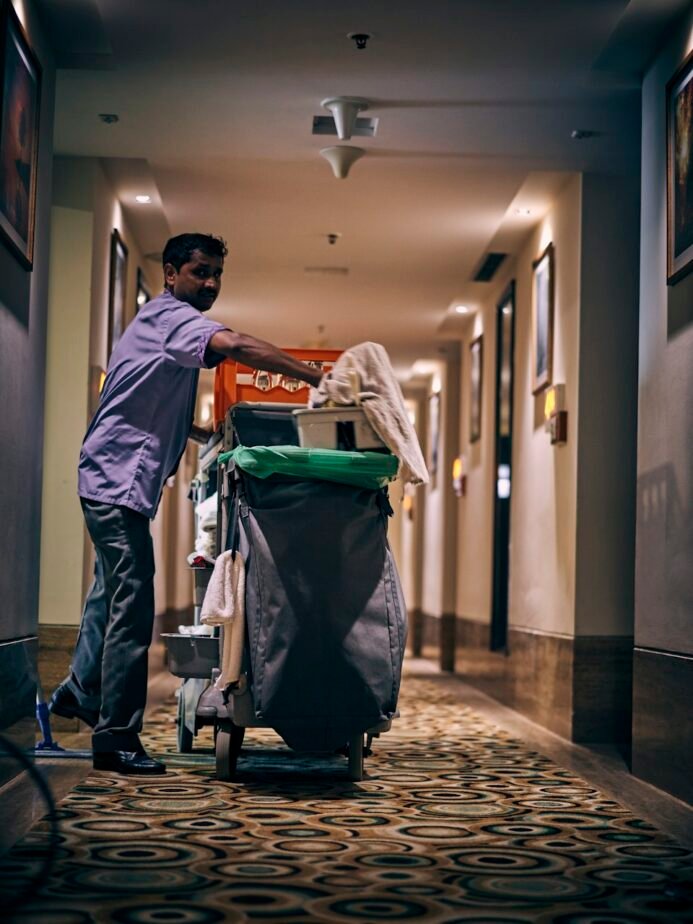
Hotel laundry operations protect room readiness, guest comfort and the useful life of linen. A good collection-to-delivery SOP is distinct from a linen par-stock calculation: the former controls the physical movement and quality of articles, while the latter estimates how many usable pieces should be in circulation. This original HoReCaHire laundry SOP provides a collection checklist, dirty/clean separation, a delivery register and supervisor audit without prescribing one chemical mixture or washing cycle for every fabric.
Hotel laundry workflow: the seven stages
| Stage | Key task | Quality or safety control |
|---|---|---|
| 1. Collection | Accept approved guestroom, restaurant or uniform linen | Identify source and applicable handling precautions |
| 2. Sorting | Separate by actual textile type, soil level and approved laundry needs | Keep soiled material from clean stock |
| 3. Washing | Use validated equipment/programme for the articles | Trained operator and actual product/fabric instructions |
| 4. Drying | Complete suitable dry cycle or approved alternative | Prevent damage and unsafe machine use |
| 5. Finishing | Inspect, iron/press or fold as appropriate | Check staining, damage and presentation |
| 6. Counting and dispatch | Match finished counts with accepted batch/department records | Record shortages and rejected pieces |
| 7. Receiving and issue | Confirm clean stock reached the correct store or floor | Authorized clean storage and receipt |
Why clean and soiled linen should not share the same workflow
Used linen can be contaminated or require special handling. Define collection routes, carts, storage, gloves or other protective equipment based on the laundry’s risk assessment and actual procedures. Do not sort or shake unknown soiled linen in a way that increases exposure; use trained processes for special contamination. The handling of healthcare laundry, hotel guest linen and food-service textiles may differ and should not be conflated.
Copy-ready hotel laundry dispatch and receipt register
| Field | Example entry | Verification |
|---|---|---|
| Batch/reference | Laundry-2026-016 (fictional) | Use unique authorized reference |
| Sending department | Housekeeping floor / banquet | Correct item category |
| Date and dispatch time | [Actual date/time] | Track turnaround |
| Article type | Bath towel / sheet / pillowcase | No mixed unspecified unit |
| Sent usable count | [Actual count] | Sender signs off |
| Received clean count | [Actual count] | Receiver confirms |
| Reject / rewash count | [Actual count and reason] | Separate usable from rewash |
| Missing / pending | Sent − (received + justified return status) | Investigate, not accuse |
| Authorized owner / next review | [Laundry lead / floor manager] | Clear follow-up |
Worked laundry reconciliation example
A fictional housekeeping batch sends 120 towels to a laundry partner. The clean delivery contains 112 accepted towels, with four documented for rewash and two verified damaged returns. Items accounted for = 112 + 4 + 2 = 118; the outstanding difference is 2 towels. It might reflect a delivery in transit, count difference or documentation issue, not automatically theft. Confirm the agreed status of rewash and rejected stock before updating usable totals.
Laundry quality inspection checklist
- Article is the correct type and not accidentally exchanged with another department.
- No visible unremoved staining or unusual residue requiring rewash.
- No unacceptable tear, hole or worn edge under the property’s textile standards.
- No unverified dampness or unsafe storage condition.
- Correct finishing/folding and quantity for the designated room/outlet.
- Clean stock protected from dirty transport and improper handling.
- Rejected articles identified separately and routed to authorized review.
- Damaged or lost pieces documented factually, without unsupported employee deductions.
Example: shift-by-shift hotel laundry coordination
| Time block | Laundry focus | Handover |
|---|---|---|
| Morning receiving | Validate yesterday’s clean returns against dispatches | Early room inventory priorities |
| Midday | Process planned collections and special approved loads | Laundry sorting and machine owner |
| Afternoon | Review urgent clean linen needs for arrivals | Housekeeping supervisor and front office |
| Evening | Record accepted output, rejects, pending work | Next shift / supplier notification |
These are examples, not prescribed shift times. Outsourced laundries, small in-house machines, guest garments and banquet linen require different schedules and contracts. Never promise a room will be ready solely because clean stock was dispatched; the room still requires normal housekeeping and release controls.
Handling guest laundry and valuables
Guest garments should carry an authorized service reference with clear agreed handling terms. Items found in pockets, suspected valuables, damaging objects or inappropriate personal information must follow the hotel’s privacy and lost-property procedures. Do not photograph labels, contents or guest garments for personal messaging. A missing garment complaint requires factual custody records and responsible guest updates, not immediate unsupported blame.
How laundry affects par stock without replacing it
Par stock accounts for linen in guestrooms, clean storage, laundries and other defined stages. A late clean return may reduce available stock without changing the numerical stock target. Managers should distinguish usable-on-shelf quantity, linen in transit, rewash, condemned items and room allocation to prevent double counting.
Specialist laundry risks and training
- Train operators on actual washing machine instructions, loads, guards and emergency stops.
- Use only approved chemicals and labelled dilutions from trained procedures.
- Keep machine, steam and electrical repairs with qualified technical professionals.
- Use risk-appropriate handling for highly soiled or potentially contaminated textile items.
- Protect workers from unsafe lifting, hot surfaces and equipment moving parts.
- Follow site-specific maintenance, ventilation and fire-safety guidance.
- Escalate any unknown contamination rather than combining it with routine linen.
Outsourced laundry SLA: questions to ask
| Commercial question | What to verify |
|---|---|
| Expected pickup and delivery | Actual schedule and agreed exception handling |
| Counting and discrepancies | Which quantities are accepted, returned or disputed |
| Quality rewash policy | Time, evidence, and who bears agreed cost |
| Textile loss or damage | Contractual process, not an assumed automatic penalty |
| Transport and hygiene | Appropriate dirty/clean segregation and storage |
| Escalation contact | Who handles urgent room-readiness impact |
Original supervisor audit scorecard
| Area | Illustrative points | Evidence |
|---|---|---|
| Count accuracy and traceability | 30 | Matched dispatch and receiving records |
| Clean/soiled separation | 30 | Observed safe storage and handling |
| Output quality | 20 | Sampled usable textile inspection |
| Communication and issue resolution | 20 | Outstanding batch owner and next action |
The 100-point rubric is an original teaching aid and cannot certify hygiene, infection prevention or legal compliance. Serious unsafe handling or contamination must be escalated even if the overall score appears high.
Related HoReCaHire housekeeping content
For job-specific responsibilities in a laundry workflow, compare the laundry attendant role, laundry machine operator role, guest laundry valet duties and laundry supervisor duties.
See the Housekeeping Supervisor guide, Housekeeping Associate role, seven housekeeping standards, and uniform and workwear policy. Managers can advertise laundry or housekeeping vacancies.
FAQs
Is a laundry movement register the same as a linen inventory?
No. Movement registers document transfers and batch status; inventory includes all accepted usable or circulating stock across locations.
Does every hotel need its own laundry plant?
No. Some properties use approved outsourced providers; responsibilities, evidence and hygiene controls should be contractually clear.
Can a hotel laundry copy hospital linen decontamination temperatures?
Do not assume that healthcare and hotel fabric workflows have the same validated process. Use appropriate textile, machine, chemical and risk-specific instructions.
Editorial note: Original HoReCaHire linen-handling, reconciliation and training examples. Laundry cycles, sanitation parameters and special-risk handling must be set by qualified operators, manufacturers and the hotel’s approved procedures; this content is not a certified decontamination method.