 HorecaHire

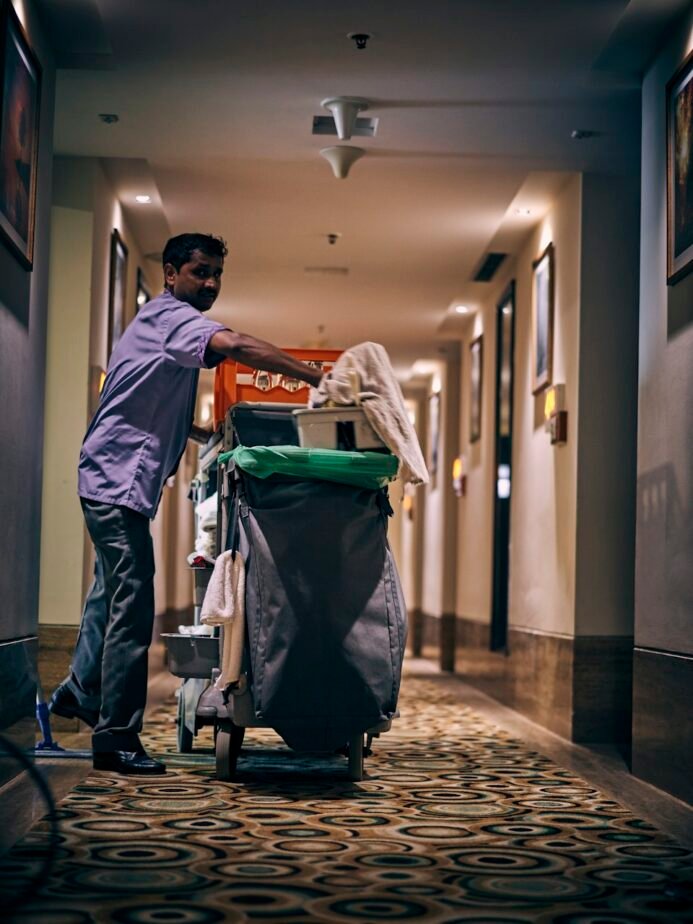
This hotel housekeeping interview guide combines 30 realistic questions, answer cues and a copy-ready practical assessment for Housekeeping Associates, Room Attendants and junior supervisors. Rather than asking candidates to memorise generic definitions, it tests whether they can protect guest privacy, spot maintenance issues, complete checks and communicate with front office. All scoring examples are original HoReCaHire templates, not an official hotel industry examination.
What hotel employers should assess
| Competency | Evidence worth looking for |
|---|---|
| Guest privacy and security | Respects DND, room-entry rules, lost property and access control |
| Cleaning and room inspection | Understands a consistent sequence and observes defects |
| Safe chemical handling | Follows instructions; doesn’t invent dangerous mixtures |
| Team communication | Updates room status and gives clear handovers |
| Guest service | Responds calmly and escalates when necessary |
| Pace with quality | Plans priorities without skipping essential checks |
30 housekeeping interview questions with model answer cues
1. What does an occupied-room status mean?
Good answer should include: Explain that it signals a room currently in use; actual PMS labels and cleaning permissions vary.
2. What is a checkout or departure room?
Good answer should include: A room needing inspection and turnover after a guest departs, subject to property status checks.
3. How do you introduce yourself at a guestroom door?
Good answer should include: Knock or announce according to the hotel’s approved room-entry SOP, identify housekeeping and wait for permission.
4. What should you do if a guest does not want service?
Good answer should include: Respect the request, update the status through approved procedures and tell the supervisor if necessary.
5. How do you handle a ‘Do Not Disturb’ notice?
Good answer should include: Follow the hotel’s DND and welfare escalation policy; do not enter just to complete a cleaning quota.
6. What is the difference between cleaning and inspection?
Good answer should include: Cleaning performs the tasks; inspection checks the completed room against agreed standards.
7. How would you prepare your housekeeping trolley?
Good answer should include: Check authorized supplies, safe storage, clean tools and separation of chemicals and linen.
8. How should cleaning chemicals be used?
Good answer should include: Follow product labels, training and approved dilution or PPE rules; never improvise mixtures.
9. What should you do with a damaged power socket?
Good answer should include: Avoid use, secure the immediate risk if trained and report to maintenance/supervisor.
10. Why are wet-floor warnings important?
Good answer should include: They communicate a slip hazard while the area is being managed according to site procedures.
11. What would you do if you find a valuable item?
Good answer should include: Use documented lost-and-found chain of custody; do not retain or photograph it personally.
12. How should a room key or access device be handled?
Good answer should include: Protect and account for it under hotel security policy; never share unauthorized access.
13. What is a room discrepancy?
Good answer should include: A difference between housekeeping room status and front-office/PMS information requiring verification.
14. How do you report a missing minibar item?
Good answer should include: Record observable facts through the authorized process; avoid accusing a guest.
15. What would you do when a guest reports an unpleasant smell?
Good answer should include: Confirm the concern, escalate the potential source and follow approved guest-room response.
16. How do you prioritize rooms during high occupancy?
Good answer should include: Use supervisor-approved arrival/departure priorities, room readiness and safety, not personal guesses.
17. What should you check in a bathroom?
Good answer should include: Use a room-inspection SOP covering cleanliness, supplies, fixtures, drains and observed defects.
18. How do you keep clean and used linen separate?
Good answer should include: Follow the property’s linen movement and hygiene procedure; avoid cross-contamination.
19. What does ‘turn-down service’ mean?
Good answer should include: A property-defined evening room-refresh service, when offered, not an automatic standard at every hotel.
20. How do you handle an unexpected guest in the room?
Good answer should include: Stop, respect privacy, introduce yourself and confirm whether service is welcome.
21. A guest asks you to repair an appliance. What do you do?
Good answer should include: Refer technical work to trained maintenance staff; don’t attempt unqualified repair.
22. How do you handle a late-arriving room request?
Good answer should include: Check staffing and approvals, communicate realistic timing and update the handover.
23. Why must room status be updated promptly?
Good answer should include: Front office relies on confirmed status for guest assignments and service recovery.
24. What is a housekeeping handover?
Good answer should include: A documented summary of open rooms, urgent defects, supplies and accountable owners.
25. How would you help a new housekeeping colleague?
Good answer should include: Demonstrate safe tasks under supervision and give respectful, specific feedback.
26. What would you say if a guest complains about dust?
Good answer should include: Listen, confirm the concern, follow authorized recovery steps and communicate the reinspection.
27. How do you prevent cross-contamination between rooms?
Good answer should include: Use the hotel’s approved tools, cloth segmentation, cleaning order and hand hygiene.
28. How would you treat guest information you see?
Good answer should include: Maintain confidentiality and access restrictions; no personal photos or messaging.
29. What if you’re unable to finish assigned rooms?
Good answer should include: Inform the supervisor early, identify barriers and agree on a safe, realistic priority plan.
30. What makes a good housekeeping employee?
Good answer should include: Reliability, attention to detail, guest privacy, safe work and clear team communication.
Practical housekeeping interview test: a safe room-inspection station
Set up an unoccupied training room or a simulated work area with permission. Candidates should not enter a genuine occupied guest room or handle hazardous chemicals during an unsupervised recruitment test. Explain the task, provide an inspection sheet and allow reasonable accommodations.
| Stage | Candidate task | Assessor observes |
|---|---|---|
| 1. Briefing | Confirm room type, check task boundaries | Asks appropriate clarification questions |
| 2. Visual scan | Identify visible defects and missing items | Prioritizes safety and guest readiness |
| 3. Safe setup | Explain cleaning tools and approved procedures | Does not mix products or ignore PPE |
| 4. Guest scenario | Respond to a hypothetical DND or room request | Respects privacy and escalates correctly |
| 5. Handover | Write a short note about unresolved findings | States issue, owner and follow-up |
Copy-ready 100-point housekeeping hiring scorecard
| Assessment area | Maximum points | Strong performance example |
|---|---|---|
| Safety and hygiene | 25 | Identifies hazard and follows safe instructions |
| Room inspection accuracy | 25 | Catches planted defects, documents specifics |
| Guest privacy and conduct | 20 | Respects access and confidentiality |
| Communication and handover | 15 | Explains issue, owner and next step |
| Work organization | 15 | Plans tasks and asks for appropriate support |
Interpretation: this weighting is an illustrative recruiter tool, not a nationally validated cut-off. Record factual observations and offer feedback; decide hiring thresholds before interviewing, and adjust for the duties, training level and workplace accessibility requirements. A fresher should not be rejected solely for unfamiliarity with one hotel’s internal software.
Printable room-inspection checklist: sample
- Room entry and privacy requirements followed.
- Linen presentation and visible bed area checked.
- Bathroom fixtures, supplies and visibly soiled areas checked.
- Waste bins and high-touch surfaces checked using site procedure.
- Lighting, electrical or plumbing defects reported, not repaired by untrained staff.
- Room supplies and amenities checked against the actual room category.
- Lost property or suspicious items escalated under policy.
- Room readiness communicated to the authorized supervisor or PMS user.
Common weak answers and stronger alternatives
| Unhelpful answer | More credible answer |
|---|---|
| “I enter every room to finish quickly.” | “I follow room-entry and DND procedures, and escalate exceptions.” |
| “I mix stronger cleaner when a stain is difficult.” | “I follow labelled product instructions and ask for approved treatment.” |
| “I fix faulty electrical equipment myself.” | “I isolate/report the issue using the maintenance procedure.” |
| “I mark the room ready without checking.” | “I complete the inspection and report discrepancies.” |
Preparing as a housekeeping fresher
Practise a realistic room checklist, learn guest privacy expectations and review safe handling from your actual training. If asked about a task you have not performed, say so and explain how you would learn it under supervision. Candidates can study the Housekeeping Associate job description and housekeeping standards guide, then use the general interview preparation resource to practise speaking.
Guidance for hotel hiring managers
Describe real shifts, lifting or movement demands, supervision and equipment access. Explain the recruitment stages and avoid unpaid productive work disguised as a hiring test. A simulation should be brief, supervised and assessed against disclosed job requirements. To advertise a real housekeeping vacancy, post a hospitality job on HoReCaHire.
Frequently asked questions
What is the best housekeeping interview answer?
The strongest answer explains a realistic safe action, the hotel’s approval process and the next step. There is rarely one universally correct phrase across all properties.
Should freshers be asked to pass an advanced room-cleaning trial?
Use tasks proportionate to the advertised role and provide safe instructions. A junior position should assess trainability as well as existing competence.
What should I bring?
Follow the interview invitation. A current resume and relevant training details may be useful; avoid sharing sensitive originals without a legitimate need.
Research and review note: The framework is aligned with common room-operations training areas covered by NCHMCT hospitality programmes. Individual employer SOPs and safe-chemical instructions remain authoritative; no claim of official certification is made.