 HorecaHire

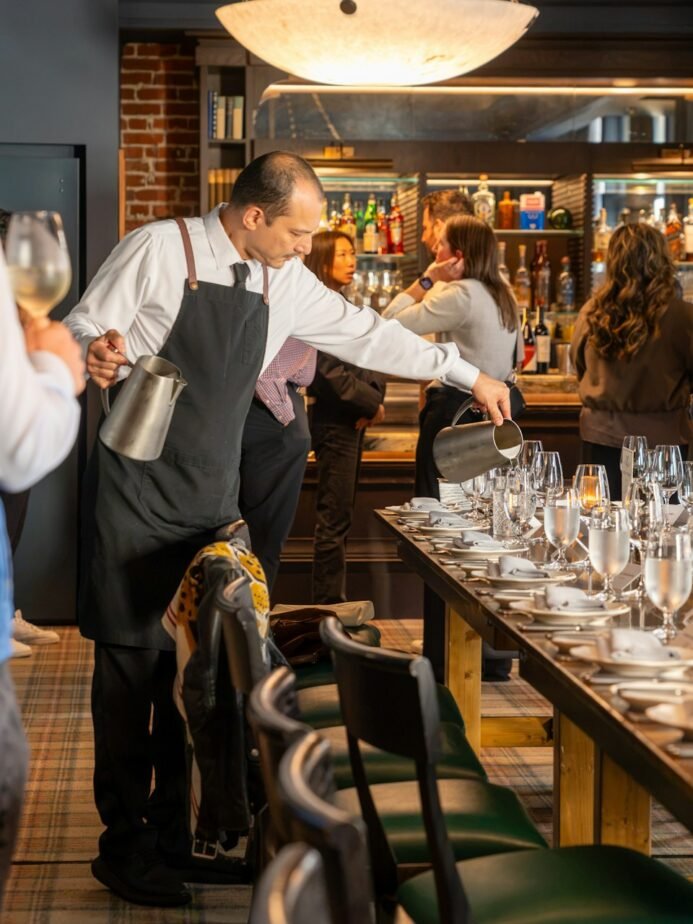
A clear restaurant sequence of service helps servers, captains and managers deliver meals accurately from the first greeting through payment and farewell. It should reflect the actual restaurant format rather than assuming every café, buffet or hotel fine-dining outlet operates identically. This original HoReCaHire F&B service sequence SOP provides a practical 12-step example, guest communication scripts, a sample pre-service checklist and a handover framework that protects guest safety and billing accuracy.
What is the sequence of service in a restaurant?
The sequence is the agreed order of guest-facing tasks such as welcoming, seating, explaining the menu, confirming an order, serving, checking satisfaction and closing the bill. A service standard defines how to perform those steps appropriately; an SOP adds responsibilities, controls and escalation. India’s NCHMCT Food and Beverage Service craft programme covers service, beverage, communications, pantry operations and menu knowledge, supporting the value of training staff on realistic task sequences.
12-step restaurant sequence of service checklist
| Step | Server or captain task | Check before moving on |
|---|---|---|
| 1. Pre-opening readiness | Confirm section, reservations, current menu, station and trained escalation contacts | Safe service area and updated information |
| 2. Welcome | Greet politely and establish the party’s request | Don’t assume booking or seating needs |
| 3. Seat | Confirm available table and relevant accessibility requirements | Use actual host or manager approval |
| 4. Explain menu | Identify current availability, specials and verified package terms | Don’t invent ingredients or prices |
| 5. Check dietary concerns | Accurately capture allergies or important restrictions | Refer to trained kitchen team; no blanket guarantee |
| 6. Take order | Record dish, quantity, modifications and table identifiers | Read back critical details |
| 7. Send and confirm | Use approved POS/KOT system and coordinate kitchen questions | Avoid duplicate tickets or unauthorized edits |
| 8. Serve | Match order to the correct guest and safe service procedure | Follow kitchen and temperature controls |
| 9. Check experience | Ask an appropriate short check-in question without interrupting excessively | Route complaints or delays promptly |
| 10. Clear appropriately | Respect course sequence and guest cues, following hygiene standards | Avoid clearing unfinished service |
| 11. Present bill | Confirm requested bill split and authorized charges | Refer changes to approved cashier/manager |
| 12. Thank and reset | Close guest interaction and prepare the table safely | Resolve or hand over open issues |
Example guest conversation: from welcome to ordering
Server: “Good evening, welcome. Do you have a reservation?” Guest: “Yes, for two.” Server: “May I confirm the booking name through our system?” After approved seating: “Would you like a moment to review the menu? I can confirm which dishes are available.” On taking the order: “May I repeat the dishes and quantities to make sure everything is right?” The conversation is fictional, for staff practice only.
Food allergy requests require a separate safety step
If a guest reports an allergy, the server should capture the exact request in the authorized ordering process, contact trained kitchen leadership and explain any uncertainty honestly. Do not treat a menu label or verbal “should be fine” as proof that a meal is safe. If cross-contact cannot be properly controlled or suitability cannot be verified, explain that clearly. Follow the restaurant’s Food Safety Management System and applicable FSSAI hygiene controls.
Sequence of service by outlet type
| Outlet | What may differ | Risk to manage |
|---|---|---|
| Full-service restaurant | Multiple courses, table assignments and guest pacing | Wrong course timing or billing |
| Hotel buffet | Welcome, buffet explanation, table clearance and replenishment | Allergen communication and clean serviceware |
| Café or quick-service | Counter ordering, queue management and pickup | Payment and order identification |
| Banquet service | BEO timings, station assignments, group communication | Guest count or programme changes |
| In-room dining | Booking confirmation, permitted access, item delivery and folio posting | Privacy and room-charge accuracy |
Pre-service briefing format for Restaurant Captains
- Confirm expected covers, group tables and reservations with the host.
- Clarify menu items that are unavailable and any authorised promotions.
- Confirm which kitchen manager handles allergen or ingredient questions.
- Assign station responsibility and identify supervision for trainees.
- Check safe table setup, serviceware and current equipment faults.
- Brief the team on unusual timing or banquet crossover.
- Clarify who can resolve bill disputes, discounts or refunds.
- Set a factual handover route for unresolved guest requests.
Five service mistakes and better alternatives
| Common mistake | Better practice |
|---|---|
| Memorising a guest order without confirmation | Repeat critical item details before sending |
| Guaranteeing a dish is allergy-free without checking | Refer to authorised kitchen verification |
| Promising “just five minutes” during a delay | Verify timing and give a realistic update |
| Making an unapproved bill adjustment | Ask a cashier or manager with permission |
| Leaving complaint details in a personal group chat | Log a minimal authorized handover with named owner |
Restaurant sequence of service assessment: 100 points
| Assessment area | Suggested points | Evidence |
|---|---|---|
| Order and bill accuracy | 25 | Correct read-back and charges escalation |
| Guest care and communication | 20 | Clear, respectful language and listening |
| Food safety / allergen judgment | 25 | Uses safe kitchen verification |
| Coordination and pacing | 15 | Manages courses and delay updates |
| Handover and teamwork | 15 | Records issue, owner and next action |
The scores above are illustrative HoReCaHire training weights, not an accredited service exam. A serious safety breach cannot be compensated by smiling or table decor. Assess staff fairly according to the real outlet and available training.
Service recovery during a delayed main course
Suppose a fictional table reports waiting longer than expected. The server should confirm the order and status with the kitchen, give the guest factual information, discuss only manager-approved alternatives and follow up after the next check. Repeated delays might indicate understaffing, ticket-routing mistakes or production limits; a service sequence cannot solve those alone.
Sequence of service handover register
| Field | Example entry |
|---|---|
| Shift / outlet | [Date, dining room, morning-to-evening] |
| Open guest issue | Table billing clarification pending; internal reference |
| What is verified | POS charge under review |
| Assigned lead | Restaurant Manager / authorised cashier |
| Guest communication | Concern acknowledged; update to follow |
| Next action | Verify source record before final adjustment |
How to train a new waiter without rote scripting
- Demonstrate the actual table and ordering workflow.
- Use a simulated menu with honest out-of-stock options.
- Have the trainee practise an allergy question and proper escalation.
- Observe accurate POS or paper-ticket entries under appropriate permissions.
- Run a short guest complaint role-play using realistic dialogue.
- Provide specific feedback and repeat supervised practice.
Related HoReCaHire hospitality content
For training across the restaurant floor, review the Restaurant Captain responsibilities, guest-complaint recovery SOP, Food Runner job description and food-allergy request log and SOP alongside this sequence-of-service SOP.
Compare the Waiter job description, Restaurant Manager checklist, guest communication scenarios, F&B Director responsibilities, and hospitality job posting.
Frequently asked questions
Do all restaurants use the same sequence of service?
No. Service style, reservations, cuisine and staffing vary. Maintain the safety and order-accuracy controls while adapting the pacing and presentation.
Is upselling a required service step?
Only where consistent with employer policy and a truthful guest-centred explanation. It should never create inaccurate claims, unsafe suggestions or coercion.
What if the POS system is offline?
Follow the approved contingency process and communicate accurate options; never collect payment through unapproved personal accounts or create undocumented transactions.
Research basis: NCHMCT’s Food & Beverage Service craft curriculum and FSSAI hygiene guidance. The sequences, service scripts, evaluation weights and fictional examples are original HoReCaHire educational tools, not an official NCHMCT test or a one-size-fits-all restaurant SOP.